
The Missing Piece: Predicting and Preventing Challenging Behaviours Before They Start
Tarryn Kihn - SupaDupaKids CEO & Clinical Psychologist
You became an educator because you want to make a difference.
You notice the small things.
You see the child who's withdrawn today when they were engaged yesterday.
You pick up on patterns that parents might not see at home.
The challenge isn't your awareness or your commitment. It's that you're making decisions without critical information about what happened before the child walked through your door.
This masterclass is about filling in the gaps.
Every day, children arrive carrying experiences you can't see.
Internal factors like hunger, pain, uncomfortable clothing, broken sleep. External factors like rushed mornings, family conflict, disappointment, changes in routine.
These setting events are the hidden context that determines whether a child will thrive or struggle in your kindy that day. When you know about them, you can respond in ways that prevent behaviours before they escalate. When you don't, you're trying to solve a puzzle without all the pieces. We are here to show you how to look for those little "red flags".
This isn't about doing more.
It's about having the information you need to do what you already do brilliantly, even better.
On-Demand Masterclass Replay Access Available for Early Childhood Educator
Purchase the Replay Access Here $97
This Masterclass Is For You If
-
You often notice things about children that others haven't picked up on yet
-
You want to understand the full picture, not just what happens during kindy hours
-
You know some children are carrying more than you can see, and you want to support them better
-
You're ready to shift from reacting to behaviours to preventing them at the source
-
You want practical ways to partner with families that feel supportive, not intrusive
-
You care deeply about getting this right for every child in your kindy

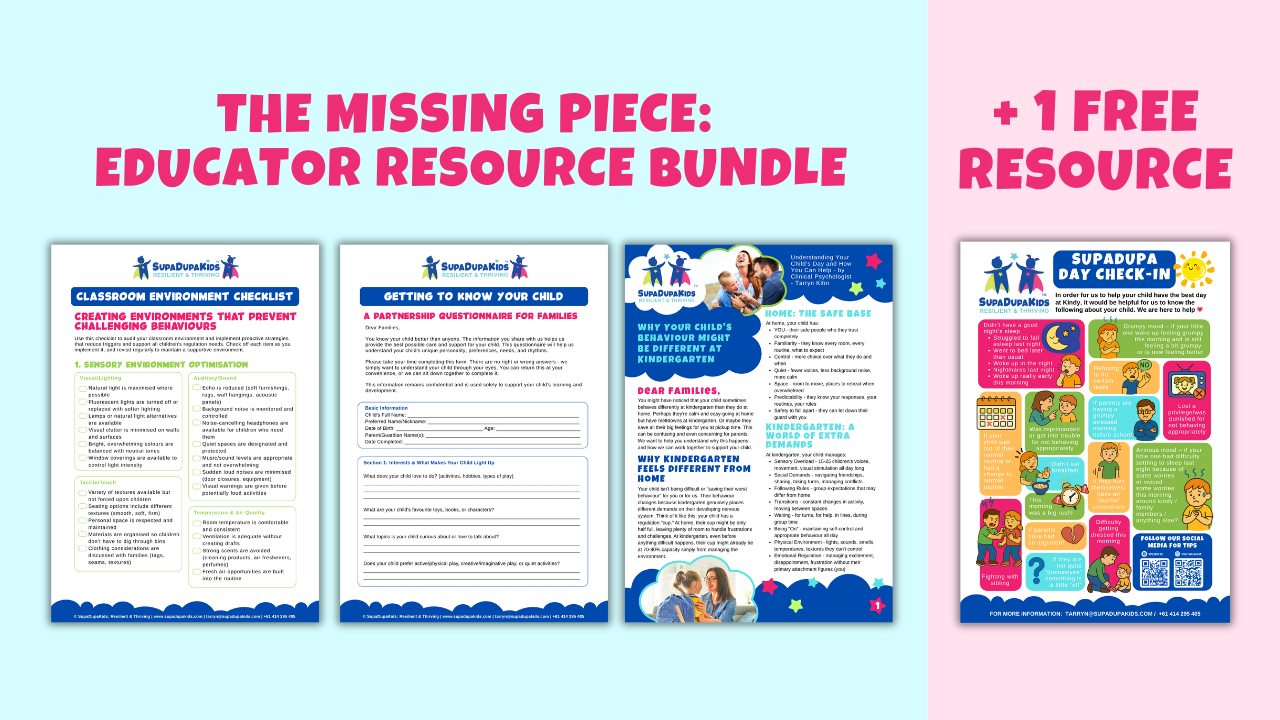
The Missing Piece: Educator Resource Bundle
These are the implementation tools live attendees received during our Missing Piece masterclass - now available for a limited time.
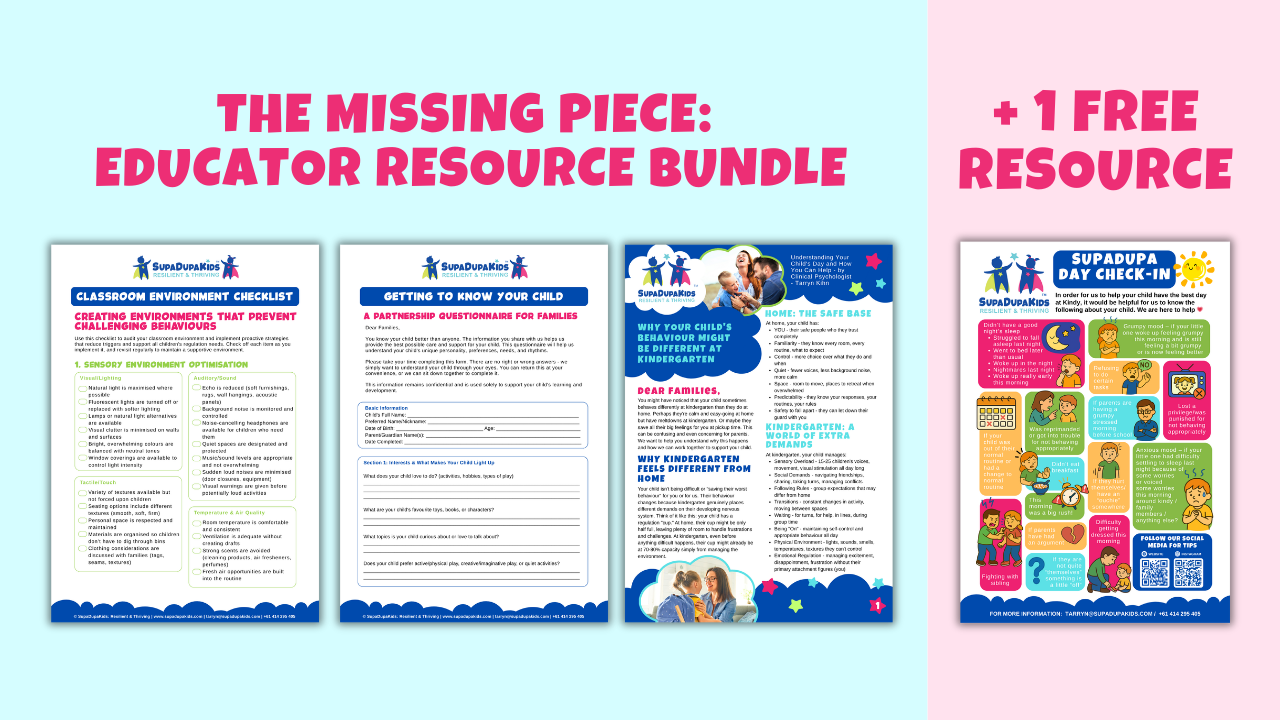
FREE RESOURCE
📚
SupaDupa Day Check-In Template
Visual poster for your classroom door. Parents point to what applies at drop-off (poor sleep, no breakfast, rushed morning, family stress). 15 seconds of information that prevents hours of challenging behaviour.
FREE Item - Download Now 👈
EXCLUSIVE RESOURCE BUNDLE
📚
Classroom Environment Checklist
Audit your space for sensory triggers, routine gaps, and regulation opportunities. Comprehensive checklist covering sound, lighting, transitions, movement, and proactive prevention strategies.
📚
Getting to Know Your Child Questionnaire
Gather critical information about each child's temperament, interests, triggers, and what helps them regulate. Use at the start of the year or when a new child joins your classroom.
📚
Parent Setting Events Guide
A simple way for families to share what's happening at home that might affect their child at kindy. Sleep, routine changes, family stress, physical health - the context you need to support children proactively.
These are practical tools you use immediately to prevent challenging behaviour instead of reacting to it. Print them. Use them. See the difference.
What We'll Cover in 45 Minutes
This masterclass is an awareness journey. It's about seeing what's been invisible, not because you weren't paying attention, but because you didn't know to look for it.
Predicting and Preventing Challenging Behaviours Before They Start
Understanding Setting Events: The Game-Changer
- What setting events are and why they're the key to predicting behaviour
- Internal factors: hunger, pain, sleep, temperature, clothing discomfort
- External triggers: family conflict, rushed mornings, disappointments, changes in routine
- How setting events interact with temperament to create behaviour
The Parent Check-In System
- How to implement a simple daily check-in that parents actually use
- The critical questions that give you the information you need
- Making it quick and non-intrusive (under 60 seconds)
- What to do with the information you gather
Proactive Prevention Strategies
- Environmental modifications that reduce triggers before they happen
- Sensory-friendly classroom strategies (lighting, noise, movement)
- Movement and proprioception opportunities that prevent dysregulation
- How to set up your space so waiting doesn't trigger meltdowns
- Transition techniques that work when kids arrive already dysregulated
Building the Foundation First
- Why relationship and attachment come before any behaviour strategy
- Practical ways to create 1:1 connection time in busy classrooms
- How to partner with parents so they feel supported, not judged
- Communication strategies that build trust quickly
You'll Walk Away With:
Practical tools and frameworks you can apply immediately
📋 The Parent Check-In System
A simple, non-intrusive way to gather critical information about setting events each morning (takes under 60 seconds)
🏫 Environment Modification Strategies
How to reduce sensory triggers through lighting adjustments, noise reduction, movement opportunities, and physical space setup
🎯 Proactive Prevention Strategies
When and how to use headphones, fidget toys, wobble cushions, heavy work activities, and transition strategies effectively
📚 Setting Events Framework
How to identify internal factors (hunger, sleep, pain, clothing) and external factors (family conflict, rushed mornings, emotional state)
💡 Building the Relationship Foundation
How to build attachment with children and partner with parents - the foundation before any strategy will work
✅ A New Perspective
Shifting from "this child is difficult" to "what happened before they arrived" and how to respond effectively
Who Is This For?
Perfect for anyone working with children aged 2-8 years who wants to move beyond surface-level behaviour management to deep understanding.

Kindergarten Educators

Primary Educators

Pre-primary Educators

Early Learning Centres
Other people who may find the information useful.

Parents

Homeschool Educators
You Deserve to Have the Full Picture
The work you do matters more than you know. You might be the one safe person in a child's world. The one who notices what others miss. The bridge between home and development.
This masterclass gives you the missing piece. Not because you weren't doing enough, but because you deserve to work with complete information.
Join us as we explore:
The Missing Piece: Predicting and Preventing Challenging Behaviours Before They Start
ABOUT YOUR FACILITATOR

Meet Tarryn Kihn, Registered Clinical Psychologist
With over 20+ years of experience working with children and families, Tarryn Kihn brings a wealth of knowledge, compassion, and practical guidance to Educators. Her expertise includes:
- Academic research in cross-cultural psychology
- Developing preventative programs to enhance children's resilience
- Training and mentoring educators in emotional and social skill development
- Supervising early career psychologists specialising in play therapy
- Extensive experience in supporting families through various challenges
Tarryn's unique ability to bridge the gap between child psychology and practical everyday examples of children’s behaviour helps educators feel confident in supporting their children's emotional growth and resilience.
Frequently Asked Questions
What if I can't attend live?
Can I attend if I'm not in Australia?
How do I access the workbook?
Will I receive a certificate?
Can I register my whole team?
What platform is this on?
Is this suitable for educators working with different age groups?
Service Testimonials

Monique Brennan, Ed Leader Country Lane said: "SupaDupaKids workshop was insightful and inspiring. It reminded us of the importance of mental health and self-reflection in our work as educators and gave us practical, relatable tools to better understand ourselves and the children we care for. The animal archetypes were a team favourite — a concept we’ll continue to use in our daily practice."
Rose Humphreys, Director of Crawford Pre-Primary said: “Our Pre-Primary educators and children benefitted enormously from this framework, the support and the skills we learned. Thank you Tarryn!”
Debbie from Grow Riverton: "Missing Piece masterclass: I found it very helpful and easy to understand. I think that there are a lot of strategies that will be easy to implement and easy to follow. I love the way it’s so simple, easy to follow and child friendly."